
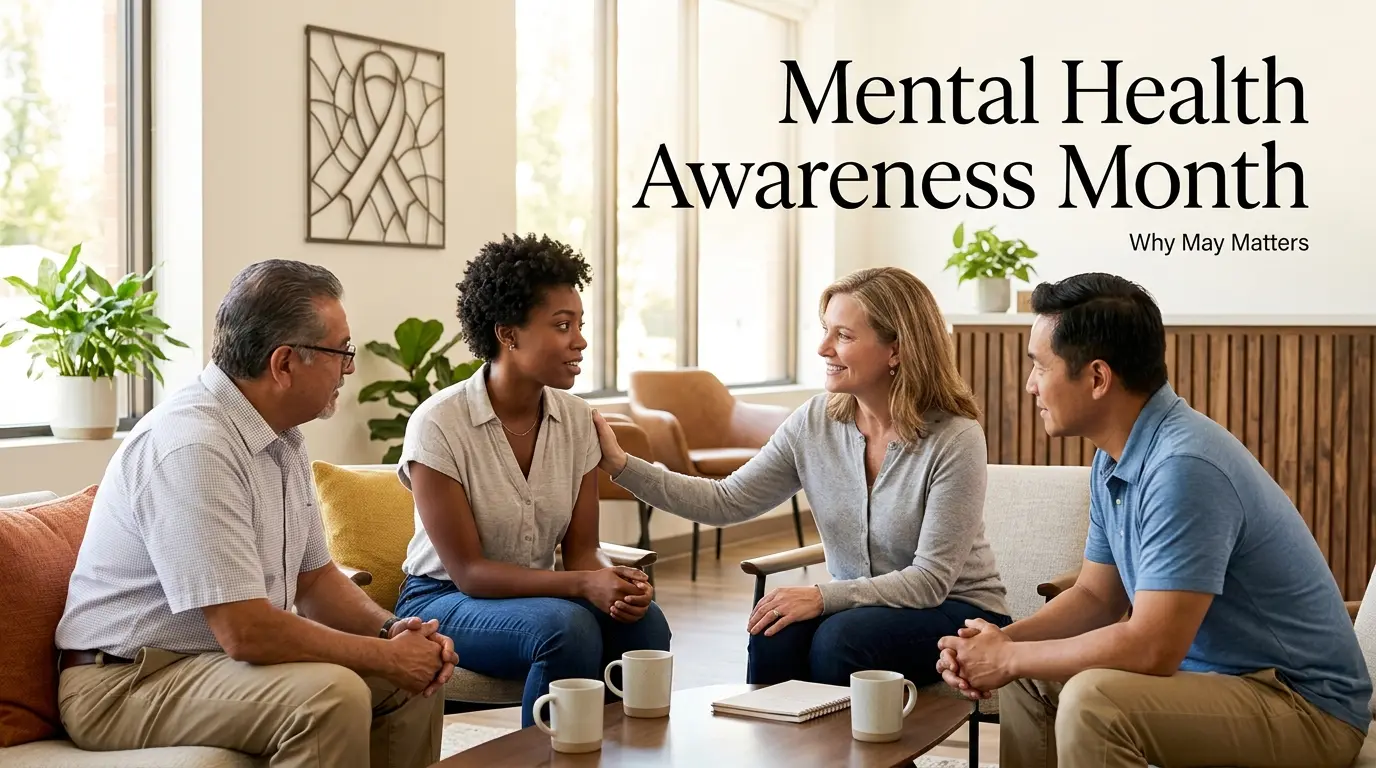
Mental Health Awareness Month is observed every May in the United States to increase understanding of mental health, reduce stigma, encourage supportive conversations, and help people connect with reliable information and care. The observance has been recognised since 1949 and provides an opportunity to talk openly about mental health and the conditions that can affect emotional, psychological, and daily functioning.
Mental health is part of overall health, and concerns can affect people of any age or background. Learning about mental health conditions can make it easier to recognise when someone may be struggling and understand that seeking professional support is a valid part of healthcare. For people living with a mental health condition, greater public understanding may also help reduce shame and isolation.
Mental Health Awareness Month is not limited to discussions about diagnoses. It can include education about emotional well-being, conversations about stigma, sharing trustworthy resources, supporting family members or friends, and encouraging people to seek help when they need it.
For readers who want to understand the broader concept first, what is mental health provides the foundation for understanding how mental health relates to thoughts, feelings, behaviour, and daily life.
The observance also helps clarify common questions about when mental health awareness is recognised, what different awareness colours and symbols mean, and how people can participate. Understanding these details can make awareness efforts more meaningful rather than simply symbolic.

When Is Mental Health Awareness Month?
Mental Health Awareness Month takes place every May in the United States. It is an annual observance focused on increasing understanding of mental health, reducing stigma, and encouraging people to seek information and support when mental health concerns affect their lives. SAMHSA identifies May as Mental Health Awareness Month and notes that the observance has been held since 1949. SAMHSA: Mental Health Awareness Month
Is May Mental Health Awareness Month?
Yes. May is Mental Health Awareness Month. During this month, individuals, healthcare organisations, schools, workplaces, community groups, and advocacy organisations may use educational campaigns and activities to promote greater understanding of mental health and mental health conditions.
The focus can include learning how mental health affects daily life, challenging harmful stereotypes, talking more openly about mental health concerns, and helping people find appropriate resources. Awareness does not replace professional assessment or treatment, but it can make conversations about seeking help easier.
Are April, June, September, or October Mental Health Awareness Months?
No. In the United States, May is the recognised Mental Health Awareness Month. Searches for other months can be confusing because different mental-health-related observances occur throughout the year.
October, for example, includes Mental Illness Awareness Week, which SAMHSA identifies as taking place during the first week of October. This is a different observance from Mental Health Awareness Month. SAMHSA: Mental Illness Awareness Week
April, June, and September may also include campaigns or observances related to particular mental health topics, conditions, or populations, but that does not make them Mental Health Awareness Month. This distinction helps prevent awareness campaigns from being treated as interchangeable when they may have different purposes.
Quick answer: May is Mental Health Awareness Month in the United States; October’s Mental Illness Awareness Week is a separate observance.
Why Is Mental Health Awareness Month Observed?
Mental Health Awareness Month is observed to increase public understanding of mental health, reduce stigma surrounding mental health conditions, and encourage people to seek appropriate support. The observance also creates opportunities for communities to share reliable information and recognise mental health as an important part of overall health.
The observance began in 1949 through the efforts of Mental Health America, originally known as the National Association for Mental Health. Since then, May has become an opportunity for organisations and communities to promote mental health education and awareness.
Awareness can be especially valuable because stigma may discourage people from talking about emotional or psychological difficulties. Misunderstandings about mental health conditions can also contribute to stereotypes or cause people to delay seeking professional help. Accurate information can replace misconceptions with a clearer understanding of what mental health conditions are and how they can affect people.
Mental Health Awareness Month also encourages conversations that extend beyond illness. Mental health includes emotional and psychological well-being, and people can experience changes in their mental health at different points in life. Learning about warning signs, understanding available resources, and knowing how to support someone can help make mental health conversations more informed and compassionate.
For people already experiencing mental health concerns, awareness efforts may provide a reminder that professional support is available. Treatment needs vary by person and condition, so awareness campaigns should encourage informed help-seeking rather than suggest that one approach works for everyone.
The previous article, what is mental health awareness, provides additional context about the broader meaning of mental health awareness and why public understanding matters.

What Are the Mental Health Awareness Month Colors and Symbols?
Mental Health Awareness Month colors, ribbons, and symbols are used to show support, encourage conversations, and draw attention to mental health. However, there is not one universally standardised colour or symbol that represents every mental health awareness campaign. Colours and visual designs can vary between organisations, campaigns, and specific mental health causes.
What Does the Mental Health Awareness Ribbon Represent?
Awareness ribbons are commonly used as visual signs of support and advocacy. In mental health campaigns, a ribbon can communicate solidarity with people experiencing mental health challenges, encourage greater understanding, and help make conversations about mental health more visible.
A ribbon should not be treated as a medical symbol or a way to identify a particular diagnosis. Its meaning depends on the campaign using it. When sharing awareness materials, it is helpful to check the organisation behind the campaign so you understand what the specific ribbon represents.
What Is the Mental Health Awareness Symbol?
A mental health awareness symbol can refer to an image, icon, ribbon, or other visual mark used to represent mental health advocacy. These symbols may appear on educational materials, social media graphics, event materials, clothing, and other awareness campaigns.
Mental health awareness shirts are another common way people participate. Wearing one can show support or help start conversations, but the message is most useful when paired with accurate information and respectful language about mental health conditions.
Because colours and symbols are not universally standardised, it is better to focus on the meaning behind an awareness campaign than assume that a particular colour or design has one official meaning. The central purpose remains increasing understanding, reducing stigma, and supporting people affected by mental health concerns.
How Does Mental Health Awareness Month Help People?
Mental Health Awareness Month can help people by making mental health information easier to discuss, reducing stigma, and encouraging people to recognise when additional support may be useful. Awareness efforts can also help families, workplaces, schools, and communities learn how to respond to mental health concerns with greater understanding and less judgement.
One benefit is improved mental health literacy. When people understand that mental health conditions can affect thoughts, emotions, behaviour, relationships, and daily functioning, they may be better prepared to recognise concerning changes in themselves or someone they care about. Awareness does not mean diagnosing another person; it means knowing when a concern may deserve attention.
Awareness campaigns can also challenge misconceptions about mental illness. Stigma may cause people to feel ashamed, misunderstood, or reluctant to discuss what they are experiencing. Using accurate language and treating mental health conditions as legitimate health concerns can help create more supportive environments.
Another important role is connecting people with reliable resources. A campaign may introduce someone to information about professional evaluation, psychotherapy, community services, crisis resources, or other forms of support. The appropriate type of help depends on the person’s circumstances, symptoms, needs, and preferences.
For loved ones, awareness can provide practical guidance about listening without judgement, respecting privacy, and encouraging professional help when appropriate. It can also remind people that supporting someone does not require them to become their therapist or healthcare provider.
Mental Health Awareness Month therefore serves a broader purpose than wearing a ribbon or sharing a message. Meaningful awareness combines education, compassion, accurate information, and appropriate pathways to support.
How Can You Participate in Mental Health Awareness Month?
You can participate in Mental Health Awareness Month by learning about mental health, sharing reliable information, challenging stigma, and supporting people who may be experiencing mental health concerns. Participation does not require a public campaign or organised event; small, respectful actions can also help create more informed and supportive communities.
Learn and Share Accurate Information
Start by learning from trustworthy healthcare and public health organisations. Understanding common mental health conditions, recognising potential warning signs, and learning about available forms of support can make conversations more informed.
When sharing information online, check the source before reposting it. Avoid claims that promise a particular treatment will work for everyone, and be cautious with content that presents mental health conditions in simplistic or stereotypical ways.
Talk About Mental Health Without Judgement
A supportive conversation can begin with listening. Give someone space to describe what they are experiencing without immediately trying to diagnose the problem or provide solutions.
Respectful language also matters. Mental health conditions are medical concerns, not character flaws, and a person’s diagnosis should not define their identity. If someone appears to be struggling, you can encourage them to speak with a qualified healthcare professional while respecting their choices and privacy.
Support Awareness in Your Community
Schools, workplaces, families, and community organisations can participate by sharing educational resources, hosting appropriate awareness activities, or making information about mental health support easier to find.
You can also support reputable organisations working to improve mental health education and access to care. The most useful awareness activities are grounded in accurate information and avoid sensationalising mental illness.
Know When Awareness Needs to Become Action
Awareness is only one part of supporting mental health. If you or someone you care about is experiencing persistent distress, significant changes in functioning, or symptoms that interfere with daily life, professional evaluation may be appropriate.
For immediate safety concerns involving a risk of suicide or serious harm, people in the United States can call or text 988 for the Suicide & Crisis Lifeline. In an immediate life-threatening emergency, call 911 or go to the nearest emergency department.

When Should You Talk With a Mental Health Professional?
Consider talking with a mental health professional when emotional, behavioural, or psychological concerns persist, cause significant distress, or begin interfering with daily life, relationships, work, school, or other important activities. A professional evaluation can help clarify what may be happening and identify appropriate support without assuming that a particular symptom automatically means a person has a mental health condition.
You do not need to wait for a crisis before asking for help. A primary care clinician, psychologist, psychiatrist, psychiatric nurse practitioner, therapist, or other qualified behavioural health professional can help assess concerns and discuss possible next steps. The type of professional and treatment that may be appropriate depends on the person’s symptoms, circumstances, preferences, and clinical needs.
It can also be helpful to seek support when someone notices persistent changes in sleep, mood, thinking, behaviour, appetite, concentration, or ability to manage normal responsibilities. These changes can have many possible causes, so professional assessment is more appropriate than trying to determine a diagnosis alone.
If you are concerned about someone else, approach the conversation with compassion rather than judgement. You can listen, acknowledge what they are experiencing, and encourage them to seek professional support when appropriate. You cannot diagnose another person or take responsibility for providing their treatment.
If someone is in immediate danger, has a serious medical emergency, or may hurt themselves or someone else, seek emergency assistance rather than relying on an awareness campaign or online information. In the United States, call 911 or go to the nearest emergency department for an immediate life-threatening emergency. For suicide or mental health crisis support, call or text 988 to reach the 988 Suicide & Crisis Lifeline.
Mental Health Awareness Month can encourage people to learn, talk, and seek support, but awareness is not a substitute for professional evaluation or treatment when someone needs clinical care.

Conclusion
Mental Health Awareness Month is observed every May in the United States to promote understanding of mental health, reduce stigma, and encourage people to seek appropriate support. It has been observed since 1949 and remains an opportunity to make conversations about mental health more informed and compassionate.
May is the month specifically recognised for Mental Health Awareness Month, while other months include separate mental-health observances. For example, Mental Illness Awareness Week takes place during the first week of October.
Whether you participate by learning about mental health conditions, sharing reliable information, supporting someone you care about, or encouraging appropriate professional help, awareness can be a meaningful step toward reducing stigma and improving understanding.
If mental health symptoms are persistent, severe, or interfering with everyday life, consider speaking with a qualified healthcare professional. If you or someone else is experiencing a mental health crisis or thoughts of suicide, call or text 988 in the United States. For an immediate life-threatening emergency, call 911 or go to the nearest emergency department.
Frequently Asked Questions
What is Mental Health Awareness Month?
Mental Health Awareness Month is an annual observance held every May in the United States. It promotes mental health education, reduces stigma, encourages supportive conversations, and connects people with information and resources. SAMHSA notes that the observance has been held since 1949.
What month is Mental Health Awareness Month?
Mental Health Awareness Month takes place in May. SAMHSA recognises it every May as an opportunity to increase awareness of the role mental health plays in overall health and well-being.
Is May Mental Health Awareness Month?
Yes. May is Mental Health Awareness Month in the United States. Organisations and communities may use the month to share educational resources, encourage conversations about mental health, and promote supportive approaches to people living with mental health conditions.
Is October Mental Health Awareness Month?
No. May is Mental Health Awareness Month. October includes Mental Illness Awareness Week, which SAMHSA recognises during the first week of October to raise awareness about mental health conditions and provide information about support and treatment.
What are the Mental Health Awareness Month colors?
There is not one universally standardised colour that represents every mental health awareness campaign. Colours and visual designs can vary by organisation or specific campaign, so the meaning of a particular colour should be checked against the organisation using it.
What does the mental health awareness ribbon represent?
A mental health awareness ribbon can serve as a visual sign of support, advocacy, and solidarity with people affected by mental health concerns. Its exact meaning can vary depending on the campaign or organisation using the ribbon.
What is the mental health awareness symbol?
A mental health awareness symbol may refer to a ribbon, icon, logo, or other visual mark used to promote awareness and support. There is not necessarily one universal symbol for every mental health campaign.
How can I participate in Mental Health Awareness Month?
You can participate by learning from reliable health sources, sharing accurate information, challenging stigma, listening without judgement, supporting someone who is struggling, or helping others find appropriate professional resources. Awareness activities are most useful when they promote accurate information and respectful conversations.
When should I seek help for my mental health?
Consider speaking with a healthcare professional when symptoms are severe, persistent, or interfere with daily activities, relationships, work, or school. NIMH recommends seeking professional help for severe or distressing symptoms that persist for two weeks or more, while also recognising that individual circumstances vary.
What should I do if I am having a mental health crisis?
If you are experiencing suicidal thoughts or emotional distress in the United States, call or text 988 for the 988 Suicide & Crisis Lifeline. If there is an immediate, life-threatening emergency, call 911 or go to the nearest emergency department.
Medically reviewed by Dr. Gloria Fosu, DNP, PMHNP-BC
Reviewed: July 26, 2026
This article was reviewed for medical accuracy by Dr. Gloria Fosu, DNP, PMHNP-BC, and is intended for educational purposes only. The information provided is not intended to diagnose, treat, or prevent any mental health condition and should not replace personalised medical advice, diagnosis, or treatment from a qualified healthcare professional.
Get Trusted Mental Health Support From Arthur Behavioral Health
Understanding mental health can make it easier to recognise concerns, reduce stigma, and know when professional support may be appropriate. Arthur Behavioural Health provides compassionate behavioural health care and reliable mental health education for individuals seeking support.
Learn more about mental health and explore support options with Arthur Behavioral Health.
References
- Substance Abuse and Mental Health Services Administration (SAMHSA). Mental Health Awareness Month. SAMHSA.
- Substance Abuse and Mental Health Services Administration (SAMHSA). Mental Illness Awareness Week (MIAW). SAMHSA.
- National Institute of Mental Health (NIMH). My Mental Health: Do I Need Help? National Institutes of Health.
- National Institute of Mental Health (NIMH). Help for Mental Illnesses. National Institutes of Health.
- National Institute of Mental Health (NIMH). Caring for Your Mental Health. National Institutes of Health.
- National Institute of Mental Health (NIMH). Tips for Talking With a Health Care Provider About Your Mental Health. National Institutes of Health.