
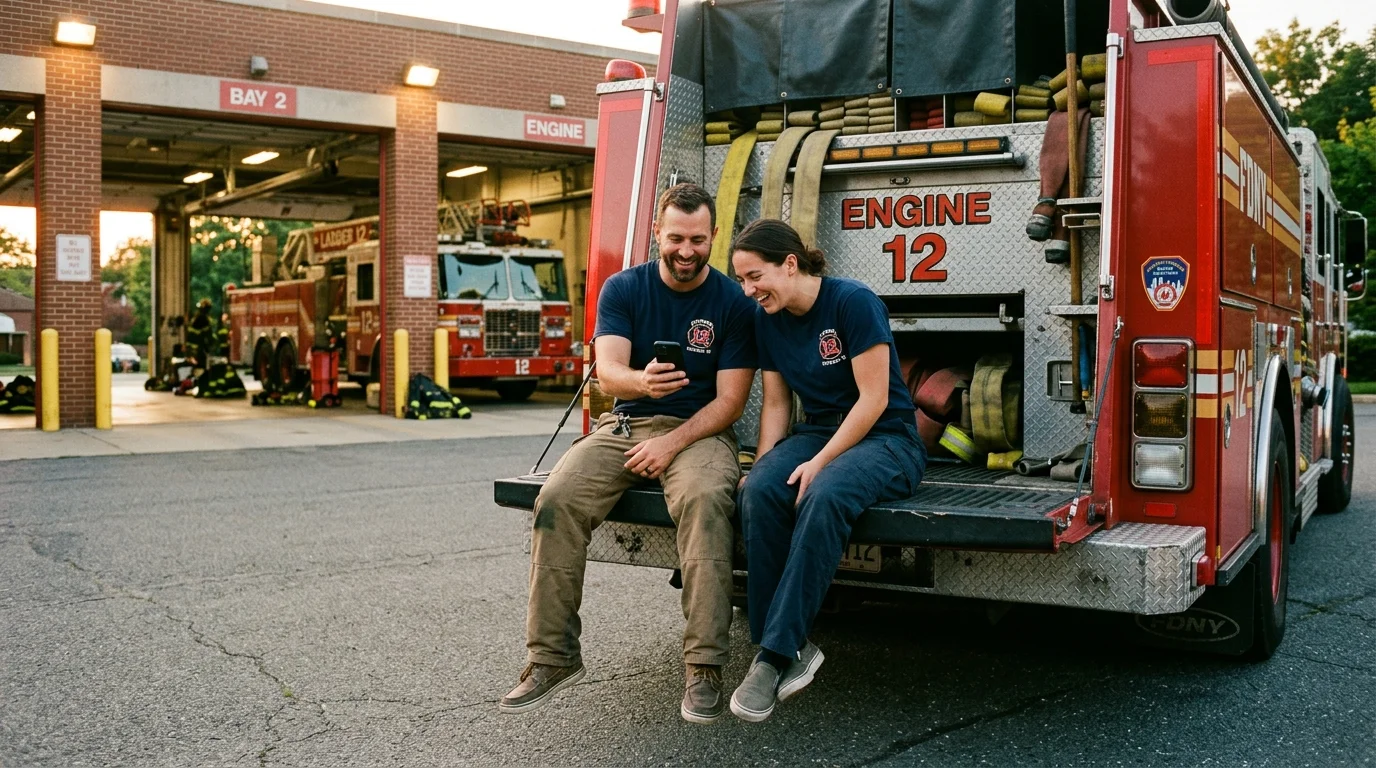
Firefighting culture runs on toughness — showing up, handling it, moving to the next call. That culture keeps crews functional under pressure, but it also makes asking for help feel like a liability. Nobody wants to be the one who can’t handle the job.
Mental health apps can’t undo that stigma, but they lower the bar for a first step. No intake form, no waiting room, no conversation with a supervisor required. This guide is part of a broader look at mental health apps worth considering, narrowed here to the tools built with fire service culture specifically in mind.
Why the Best Mental Health Apps for Firefighters Look Different
Firefighters face a mental health burden that’s measurably higher than the general population’s. Firefighters are roughly twice as likely as the general population to experience PTSD, according to the IAFF Center of Excellence, and cumulative trauma exposure across a career compounds in a way single traumatic events don’t.
Stigma is the central barrier, not access. Many departments do offer an Employee Assistance Program, but firefighters routinely avoid using it out of concern that seeking help could affect their standing, their assignment, or how their crew sees them.
That’s why the apps that actually get used in this space share specific traits: anonymity by design, no requirement to loop in a department or chief, and content built around shift work, critical incidents, and cumulative trauma rather than generic “stress relief.”

How We Evaluated These Apps
Every app below was checked against five criteria: cost, anonymity/privacy from the department, whether it was built with fire/EMS input, evidence base, and platform availability.
One note before the list: a handful of well-known first-responder wellness platforms — Cordico and PowerLine among them — are licensed to fire departments rather than sold to individuals, so you may already have access through your employer without realizing it. We’ve flagged that distinction below where it applies.
The Apps
Here’s the lineup: apps you can download and use tonight, plus one department-provided platform worth asking about if your agency hasn’t rolled it out yet.
CrewCare
CrewCare is a free app built specifically for first responders, including fire, EMS, law enforcement, and dispatch. It uses short check-ins on mood, sleep, finances, and career stress to build a personal picture of cumulative stress over time, then shows you how your results compare anonymously to others in the field.
Data is aggregated and non-identifiable, which was a deliberate design choice to encourage honest answers without fear of it getting back to a supervisor. It also links out to relevant crisis and mental health resources.
Best for: Firefighters who want to track cumulative stress over a career, not just react to a single bad call.
Limitation: It’s an awareness and tracking tool, not a treatment tool — it points you toward help rather than providing therapy itself.
ResponderRel8
ResponderRel8 is a peer-to-peer chat app built exclusively for emergency responders, including firefighters, EMS, law enforcement, and dispatch. Users connect anonymously in topic-based chat rooms to talk through what the job is actually like with people who understand it without explanation.
It’s explicit that it isn’t a crisis service — if a user appears to be in crisis, the app directs them to call 911 or the Safe Call Now first-responder crisis line rather than trying to handle it peer-to-peer.
Best for: Firefighters who want to vent or connect with peers outside their own department, without anyone at the station knowing.
Limitation: Peer support isn’t a substitute for clinical care, and the anonymous chat-room format means you’re not guaranteed a response from someone trained in crisis intervention.
PTSD Coach
PTSD Coach was built by the VA’s National Center for PTSD, primarily with veterans in mind, but its content on trauma symptoms, self-assessment, and grounding techniques applies directly to the occupational trauma firefighters accumulate on the job. It’s free and doesn’t require any account or login.
Firefighters have adopted it informally as a self-help tool even though it wasn’t marketed to them specifically, largely because there’s no comparable fire-service-branded equivalent with the same depth of clinical content.
Best for: Firefighters managing PTSD-type symptoms — nightmares, hypervigilance, intrusive memories — who want a private, VA-caliber tool.
Limitation: It’s not branded or tailored for fire service culture specifically, so some of the framing and examples reference military rather than fire scenarios.
Wysa
Wysa is an AI chatbot built on cognitive behavioral therapy principles, designed for anonymous, judgment-free conversations about stress, anxiety, or anger at any hour. The core chat function and a library of self-help exercises are free; a premium tier with expanded tools runs about $75 a year, and optional human coaching is available at an added cost.
Its low-friction, no-human-required format makes it a common entry point for people who aren’t ready to talk to a person yet, firefighters included — Wysa is used by NHS-affiliated services and has been independently reviewed for clinical safety.
Best for: Firefighters who want a quick, anonymous outlet between calls, without committing to a person or a schedule.
Limitation: It’s an AI tool, not a licensed clinician — useful for day-to-day coping skills, not for diagnosing or treating PTSD.

Headspace
Headspace is a mainstream meditation app offering guided sessions, sleep content, and short stress-relief exercises that fit into the gaps of a 24-hour shift. It’s subscription-based, typically running in the range of $70 a year, though discount and trial offers appear periodically.
The appeal for firefighters is discretion: a five-minute breathing exercise between calls doesn’t look like “getting help” to anyone watching, which matters in a culture where visible vulnerability can carry a cost.
Best for: Firefighters who want a low-key stress tool that doesn’t require explaining anything to anyone.
Limitation: It’s general wellness content, not built around occupational trauma or critical-incident stress, so it works best paired with a more targeted tool.
BetterHelp
BetterHelp connects users with a licensed therapist for video, phone, or messaging sessions, priced roughly $260–$400 per month depending on plan and location, with a financial aid application available in the sign-up flow. It’s the one licensed-clinician option on this list, as opposed to a self-guided tool.
For firefighters without department-provided EAP access, or who don’t trust that access to stay confidential, BetterHelp offers a way to get matched with a therapist entirely outside the department’s system.
Best for: Firefighters who want licensed therapy without going through a department-affiliated provider.
Limitation: Therapists aren’t automatically matched for first-responder experience — it’s worth explicitly requesting one with trauma or public-safety background rather than assuming it by default.
Cordico
Cordico is a wellness platform many fire departments license directly, giving members access to self-assessments, on-demand wellness content, and — depending on the department’s package — direct connection to department-vetted clinicians. Unlike the apps above, it’s typically not something you download and pay for individually; access comes through your agency.
If your department hasn’t mentioned it, it’s worth asking your union rep or wellness coordinator whether a platform like Cordico or a similar service is already part of your benefits. A growing number of departments have added one in recent years without heavily promoting it.
Best for: Firefighters whose department already provides department-vetted clinical access through a licensed platform.
Limitation: Availability depends entirely on whether your specific department has purchased it — there’s no individual sign-up path if yours hasn’t.
Comparison Table
| App | Best For | Price | Platform |
|---|---|---|---|
| CrewCare | Tracking cumulative stress | Free | iOS, Android |
| ResponderRel8 | Anonymous peer chat | Free | iOS, Android |
| PTSD Coach | PTSD-type symptoms | Free | iOS, Android |
| Wysa | Quick anonymous coping support | Free, premium ~$75/year | iOS, Android |
| Headspace | Discreet mindfulness between calls | ~$70/year | iOS, Android, Web |
| BetterHelp | Licensed teletherapy | ~$260–$400/month, financial aid available | iOS, Android, Web |
| Cordico | Department-provided wellness platform | Varies (department-licensed) | iOS, Android |
Choosing an App as a Firefighter
Anonymity is the single biggest factor for this audience, more than for almost any other group covered in this series. An app that requires a work email, a department code, or any identifiable login is going to see lower honest engagement than one that doesn’t — CrewCare and ResponderRel8 were both built around that insight directly.
Shift work also shapes what’s actually usable. A firefighter finishing a 24-hour shift at 7 a.m. isn’t going to book a same-day therapy appointment, but they might use a five-minute breathing exercise or send a message in a peer chat room before they fall asleep. Tools built for micro-moments tend to get used; tools that require scheduling tend not to.
The hypervigilance and sleep disruption common after military service, covered in more depth in our veterans guide, shows up in fire service too — cumulative exposure to trauma produces overlapping symptoms regardless of the uniform.
When an App Isn’t Enough
None of these apps are a substitute for treatment of PTSD, depression, or substance use that’s affecting your ability to function — on shift or at home. Peer support and self-guided tools genuinely help, but they work best as a supplement to professional care, not a replacement for it.
If you’re noticing signs like persistent sleep disruption, increased irritability with family, or turning to alcohol more than you used to, that’s worth bringing to a clinician, whether through your department’s EAP, Safe Call Now, or a private therapist outside the department system entirely.
If you’re in crisis, contact the 988 Suicide & Crisis Lifeline or Safe Call Now, a 24/7 confidential crisis line staffed by current and former first responders, rather than relying on an app in the moment.

FAQ
Are there mental health apps made specifically for firefighters?
Yes. CrewCare and ResponderRel8 were both built specifically for first responders, including firefighters, with features like anonymous peer chat and cumulative stress tracking designed around fire and EMS culture rather than general wellness.
Will my department know if I use one of these apps?
Apps like CrewCare, ResponderRel8, Wysa, and BetterHelp don’t share your activity with your employer. Department-licensed platforms like Cordico may have different visibility depending on your agency’s specific setup, so it’s worth confirming with your union or wellness coordinator.
Can an app replace therapy for PTSD or critical-incident stress?
No. Apps can help with day-to-day coping and provide a private first step, but PTSD and cumulative trauma from the job typically require evidence-based therapy from a licensed provider trained in first-responder or trauma-focused care.
What if my department doesn’t offer any mental health resources?
Several free options don’t require department involvement at all, including CrewCare, ResponderRel8, and Wysa’s free tier. Safe Call Now and the 988 Lifeline are also available regardless of what your department provides.
Is it actually confidential to use these apps?
Independently downloaded apps like CrewCare, ResponderRel8, and BetterHelp keep your activity private from your employer by design. Confidentiality practices vary for department-provided platforms, so check your specific agency’s policy rather than assuming.
Closing
Fire service culture doesn’t change overnight, but the tools available to individual firefighters have gotten a lot more private and a lot more specific to the job. Start with whichever one matches your actual need — tracking, venting, or talking to someone licensed — rather than trying to force one app to do everything.
If you or someone on your crew is in crisis, Safe Call Now (206-459-3020) and the 988 Suicide & Crisis Lifeline are both available 24/7, confidentially, regardless of department affiliation.
This article is for informational purposes and isn’t a substitute for professional mental health care.